Thứ Năm, 2 tháng 11, 2017

Meet the singer Taylor Swift calls 'little sis'

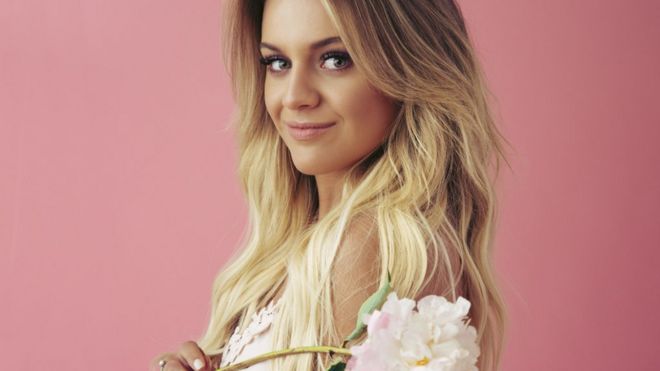
Kelsea BalleriniImage copyrightSONY MUSIC / BLACK RIVER
Image captionKelsea Ballerini: "I grew up on a farm in Eastern Tennessee and country is where my roots are"
Earlier this year, Kelsea Ballerini got to go to the Grammys for the first time.
The 24-year-old was up for best new artist, and scheduled to perform with Lukas Graham - but she was still a little star-struck.
"My mum was my date - and we were both sitting there fan-girling like, 'Oh my God, that's Adele! Don't look! Don't look!'"
Ballerini, it turns out, is not the sort of person who keeps her cool when she meets an idol.
"The first time I met Carrie Underwood was at the Opry, before I had a record deal," she recalls.
"I was waiting backstage with a bunch of people to say hello and finally it was my turn.
"I was going to say something normal - but then I saw her and went "Girl! You got so much sooouul!".
"Of all the things I could have said, that's what I chose," she grimaces. "It was very weird."
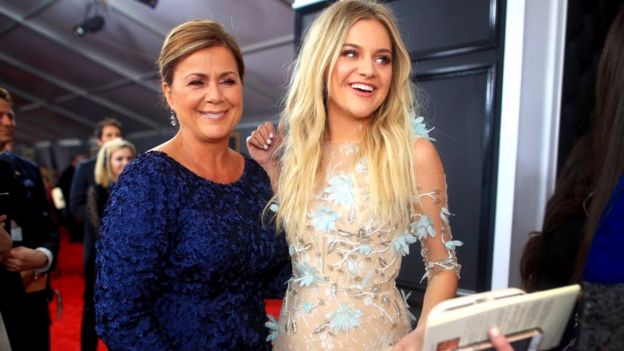
Kelsea Ballerini and her mother, CarlaImage copyrightGETTY IMAGES
Image captionThe singer promised her mum, Carla, she'd take her to the Grammys when she was 13 years old
Awkward celebrity encounters aside, Ballerini has been living in a fairytale for the last few years.
She released her debut album, The First Time, in 2015 and watched its first three singles go to number one on Billboard's country airplay chart - an historic achievement for a female artist.
The bubbly, vivacious melodies and autobiographical lyrics of Love Me Like You Mean It and Peter Pan won comparisons to Taylor Swift, who quickly befriended the artist (she calls Ballerini her "little sis") and invited her onto her 1989 world tour.
That led to her Grammy appearance and, at next week's Country Music Association Awards, a nomination for female artist of the year.
All told, it's turned out pretty well for someone who was shunned by the establishment when she first arrived in Nashville.
"I could not get into a room with a hit writer to save my life," she recalls of making her first album.
"I was a new girl, on an independent label and those were two strikes against me. No-one would write with me."
It turned out to be a blessing. Left to her own devices, Ballerini, whose first concert was Britney Spears, channelled her love of pop and R&B into the album, giving her songs a vitality and immediacy that's sometimes missing from traditional country.
The star's co-producer, Forest Glen Whitehead, even refers to her as a "country Beyonce".
"I grew up on a farm in Eastern Tennessee and country is where my roots are," explains the singer, "but I listen to rap and I listen to R&B and I love pop.
"I've always been open about that because, as a songwriter, I always want to make sure that I'm trying new things."

Kelsea BalleriniImage copyrightSONY MUSIC / BLACK RIVER
Image captionThe singer moved to Nashville aged 15 with her mother but struggled to be accepted by the country music establishment
Despite the strength of her singles, Ballerini still faced an uphill struggle in the insular world of country.
Her debut came out in the midst of what's been called "tomato-gate", where radio consultant Keith Hill advised stations not to play too many songs by women and not to play two women back to back.
"If you want to make ratings in country radio, take females out," he told trade publication Country Radio Aircheck. "They're just not the lettuce in our salad. The lettuce is Luke Bryan and Blake Shelton, Keith Urban and artists like that. The tomatoes of our salad are the females."
Like many others, Ballerini was perplexed by his comments.
"When you think of country music history obviously you have George Jones, Garth Brooks, George Strait - all these iconic males. But you cannot talk about the history of country music without Loretta Lynn, Dolly Parton, Shania Twain. I mean some of the biggest artists in country music history are female."
In the end, she thinks, the uproar over Hill's comments helped her cause.
"Love Me Like You Mean It was in the top five when tomato-gate came out - and I think radio stations went, 'Well, watch this!' and helped me get to number one."

Kelsea BalleriniImage copyrightGETTY IMAGES
But how do you follow up such a successful debut? With great difficulty, says Ballerini.
"I didn't know how to make my second record for a long time.
"The first one worked so well that I was like, 'How do I make that record again?' And then I realised I can't. That's not who I am any more."
The answer was simple: Write an album about the person she's become - and luckily Ballerini had a lot of material to draw on.

No more love songs?

Unapologetically, released this Friday, is the chronological story of the last two years, as the singer left behind a "gross break-up" and got engaged to fellow country singer Morgan Evans.
One of the first tracks is Miss Me More, a slinky stomp in which the singer describes how her ex-boyfriend slowly eroded her identity.
"I retired my red lipstick 'cause you said you didn't like it," she sings. "I didn't wear my high heel shoes / 'Cause I couldn't be taller than you."
"In a lot of young relationships, you fall in love for the first time and you give every part of yourself to make it work," she explains. "But sometimes, when it's not treated right, that's how you lose yourself.
"I think it's really a beautiful moment when you get to the other side, and you're looking in the mirror and you're like, 'Huh, I thought I was going to miss him but - actually - I miss me!'"


BT profits dented by sports rights investment

BT sign in windowImage copyrightBT
Profits at BT dipped in the second quarter partly due to higher payments for sports rights and a slowdown in its global corporate services division.
The company said other factors holding back profits included investment in customer service, and higher pension costs and business rates.
BT said it was taking "robust actions" to improve the performance of global services.
The company said market conditions in the division continued to be "challenging". It is cutting back staff numbers and has shed 1,500 posts so far this year, with a further 1,500 roles to go in the second half of the year. Another 1,000 will be cut next year.

Mobile growth

BT said operating costs in its consumer business had risen by 2%, due to investment in new UK customer service roles and additional sports rights costs from the Premier League, Box Nation and the Ashes.
Investment in customer services has led to an improvement in waiting times, with calls now answered almost four minutes faster than last year, on average after 74 seconds.
BT chief executive Gavin Patterson said the company's cost-cutting programme was on track to deliver savings of £400m.
He also said BT was "committed" to delivering ultrafast internet speeds to 12 million premises by the end of 2020.
BT, which bought mobile operator EE last year, said it added 279,000 mobile subscribers in the past quarter taking the total number of its contract customers to 17.3 million. In total, it now has almost 30 million mobile customers.
The company also said it was continuing to sort out its Italian business, where earlier this year it said it had uncovered years of "inappropriate behaviour" and improper accounting practices.

Related Topics

Early blood test could indicate risk of miscarriage

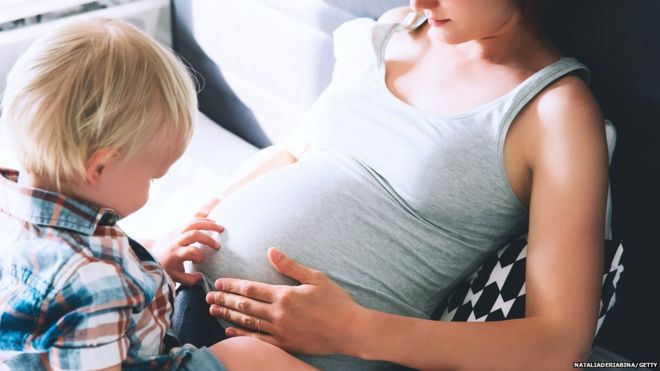
Pregnant mother with young childImage copyrightNATALIADERIABINA/GETTY
A blood test in the first 12 weeks of pregnancy could indicate a risk of miscarriage or premature birth, early research suggests.
US doctors believe they have found molecules in the blood that can be linked to serious birth complications, months before symptoms are apparent.
The findings could help doctors take steps to avoid premature birth.
But experts warned against overstating the findings, citing the "small and preliminary" nature of the research.
In the UK, one in five pregnancies ends in miscarriage, while Britain has one of the highest rates of premature birth in Europe.
The proposed blood test screens for molecules called microRNA, which are found in blood cells in the placental bed - a thick membrane that lines the uterus during pregnancy.

Predicting problems

The team, from the Laboratory for Reproductive Medicine and Immunology in San Francisco, assessed the microRNA cells' ability to predict premature birth, pre-eclampsia, and miscarriage during the first 12 weeks of pregnancy.
In total, they looked at 160 births - over a series of four published studies.
The results predicted miscarriage and late pre-eclampsia with about 90% accuracy and premature birth before 34 weeks with about 89% accuracy.
Pre-eclampsia is a serious condition where abnormally high blood pressure and other problems develop during pregnancy.
It affects up to 10% of all first-time pregnancies and often leads to premature birth.
Unlike that of miscarriage, the risk of pre-eclampsia and premature birth can be managed by medical intervention.
The study authors said the test could possibly be used in combination with other established screening tests.

'Root cause'

Daniel Brison, honorary professor of clinical embryology and stem cell biology at the University of Manchester, said the study was "exciting looking" in a much needed area.
But he added: "Although the results might seem exciting and cutting edge, there is unfortunately a high risk of them being wrong.
"We'd need larger follow-up studies to be sure whether these results are valid."
Tim Child, associate professor at the University of Oxford and medical director of Oxford Fertility, echoed his concerns but described the research as important.
"Pre-eclampsia, premature birth and miscarriage are significant issues all around the world, so any research is important," he told BBC News, stressing that "while the number [of cases studies] is very limited, the statistical relationship between the test and the complication is very high."
He added that he hoped ongoing research would help doctors understand "the root cause" of placental disease.

My life as an al-Qaeda hostage

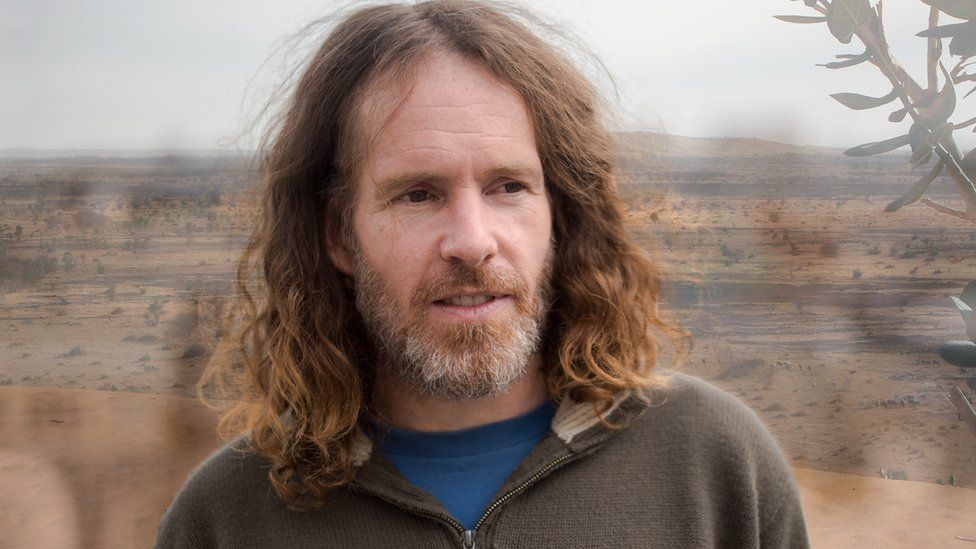
Stephen McGown set off from London on his motorbike for a trip of a lifetime to South Africa. But in Timbuktu he was kidnapped by Islamist militants.
Stephen McGown, composite image
Composite image subject to copyright

Donald Trump expected to pick Jerome Powell as Fed chair

Jerome PowellImage copyrightREUTERS
Image captionJerome Powell was appointed to the Federal Reserve board in 2012
President Donald Trump is planning to name Jerome Powell as his choice to lead the US central bank, according to US media reports.
Mr Powell, a Republican and multi-millionaire, is already a member of the bank's board.
The president is set to announce his nominee for Federal Reserve chair later on Thursday.
He interviewed five candidates for the role, including current chair Janet Yellen whose term finishes in February.
Mr Powell, who has an estimated income of between $20m and $55m (£15m-£41m), has been widely tipped as the top choice for over a week.
His nomination would break with tradition, which sees presidents historically sticking with the Federal Reserve chairs appointed by their predecessors.
"I think Janet Yellen is excellent," Mr Trump told reporters during a meeting with his cabinet on Wednesday.
But asked if she was his pick, the president said: "I didn't say that."
He predicted people would be "extremely impressed" with the nominee, who will require Senate confirmation.
Mr Powell is a lawyer by training and a former partner in the Carlyle Group - one of the world's biggest investment companies.
He was appointed to the Federal Reserve board in 2012 and has voted with the majority on issues such as interest rates.

'Big void' identified in Khufu's Great Pyramid at Giza


Media captionMark Lehner: "A space that the builders left to protect the grand gallery?"

The mysteries of the pyramids have deepened with the discovery of what appears to be a giant void within the Khufu, or Cheops, monument in Egypt.
It is not known why the cavity exists or indeed if it holds anything of value because it is not obviously accessible.
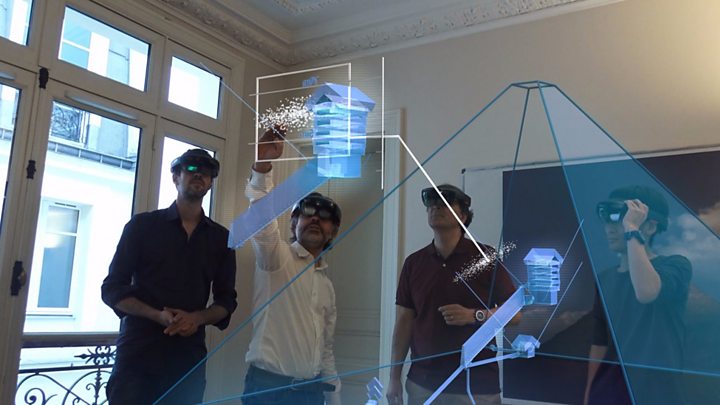
Japanese and French scientists made the announcement after two years of study at the famous pyramid complex.
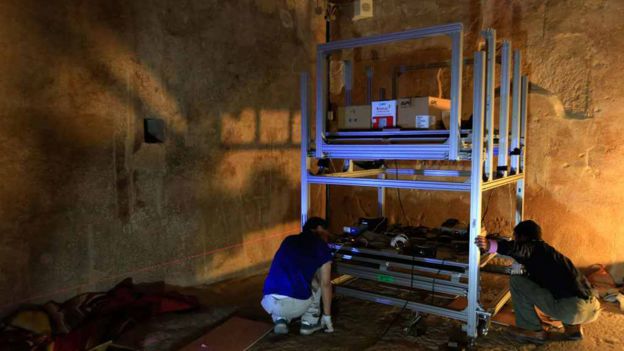
They have been using a technique called muography, which can sense density changes inside large rock structures.
The Great Pyramid, or Khufu's Pyramid, was constructed during the reign of Pharaoh Khufu between 2509 and 2483 BC.
At 140m (460 feet) in height, it is the largest of the Egyptian pyramids located at Giza on the outskirts of Cairo.

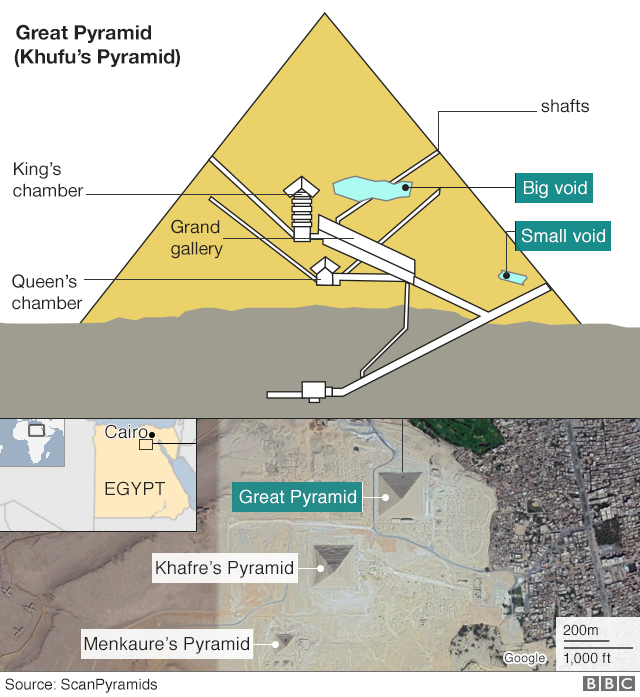
Diagram of pyramid interior

  • ScanPyramids has already detected a smaller void on the northern face
  • The new cavity is perhaps 30m long and several metres in height
  • All three muon technologies sense the same feature in the same place

Presentational grey line

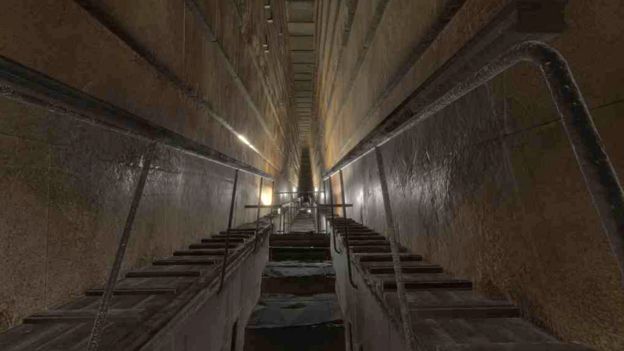
Khufu famously contains three large interior chambers and a series of passageways, the most striking of which is the 47m-long, 8m-high Grand Gallery.
The newly identified feature is said to sit directly above this and have similar dimensions.
"We don't know whether this big void is horizontal or inclined; we don't know if this void is made by one structure or several successive structures," explained Mehdi Tayoubi from the HIP Institute, Paris.
"What we are sure about is that this big void is there; that it is impressive; and that it was not expected as far as I know by any sort of theory."

Grand GalleryImage copyrightSCANPYRAMIDS
Image captionThe newly found void is directly above the Grand Gallery

The ScanPyramids team is being very careful not to describe the cavity as a "chamber".
Khufu contains compartments that experts believe may have been incorporated by the builders to avoid collapse by relieving some of the stress of the overlying weight of stone.
The higher King's Chamber, for example, has five such spaces above it.
The renowned American archaeologist Mark Lehner sits on a panel reviewing ScanPyramids' work.
He says the muon science is sound but he is not yet convinced the discovery has significance.
"It could be a kind of space that the builders left to protect the very narrow roof of the grand gallery from the weight of the pyramid," he told the BBC's Science In Action programme.
"Right now it's just a big difference; it's an anomaly. But we need more of a focus on it especially in a day and age when we can no longer go blasting our way through the pyramid with gunpowder as [British] Egyptologist Howard Vyse did in the early 1800s."


Media captionMehdi Tayoubi: "It's a big void, similar to the Grand Gallery, but what is it?"

One of the team leaders, Hany Helal from Cairo University, believes the void is too big to have a pressure-relieving purpose, but concedes the experts will debate this.
"What we are doing is trying to understand the internal structure of the pyramids and how this pyramid has been built," he told reporters.
"Famous Egyptologists, archaeologists and architects - they have some hypotheses. And what we are doing is giving them data. It is they who have to tell us whether this is expected or not."
Much of the uncertainty comes down to the rather imprecise data gained from muography.
This non-invasive technique has been developed over the past 50 years to probe the interiors of phenomena as diverse as volcanoes and glaciers. It has even been used to investigate the failed nuclear reactors at Fukushima.
Muography makes use of the shower of high-energy particles that rain down on the Earth's surface from space.
When super-fast cosmic rays collide with air molecules, they produce a range of "daughter" particles, including muons.
These also move close to the speed of light and only weakly interact with matter. So when they reach the surface, they penetrate deeply into rock.
But some of the particles will be absorbed and deflected by the atoms in the rock's minerals, and if the muon detectors are placed under a region of interest then a picture of density anomalies can be obtained.

Muon detectosImage copyrightSCANPYRAMIDS
Image captionThe muon detectors have to be placed under the region of interest

The ScanPyramids team used three different muography technologies and all three agreed on the position and scale of the void.
Sébastien Procureur, from CEA-IRFU, University of Paris-Saclay, emphasised that muography only sees large features, and that the team's scans were not just picking up a general porosity inside the pyramid.
"With muons you measure an integrated density," he explained. "So, if there are holes everywhere then the integrated density will be the same, more or less, in all directions, because everything will be averaged. But if you see some excess of muons, it means that you have a bigger void.
"You don't get that in a Swiss cheese."
The question now arises as to how the void should be investigated further.
Jean-Baptiste Mouret, from the French national institute for computer science and applied mathematics (Inria), said the team had an idea how to do it, but that the Egyptian authorities would first have to approve it.
"Our concept is to drill a very small hole to potentially explore monuments like this. We aim to have a robot that could fit in a 3cm hole. Basically, we're working on flying robots," he said.
Jonathan.Amos-INTERNET@bbc.co.uk and follow me on Twitte

Nam thanh niên tử vong do cờ cổ vũ bóng đá cuốn vào containe

Xe container va chạm với một môtô đi ngược chiều, khiến nam thanh niên ngồi sau xe máy ngã xuống đất, bị bánh sau của container chèn tử von...